
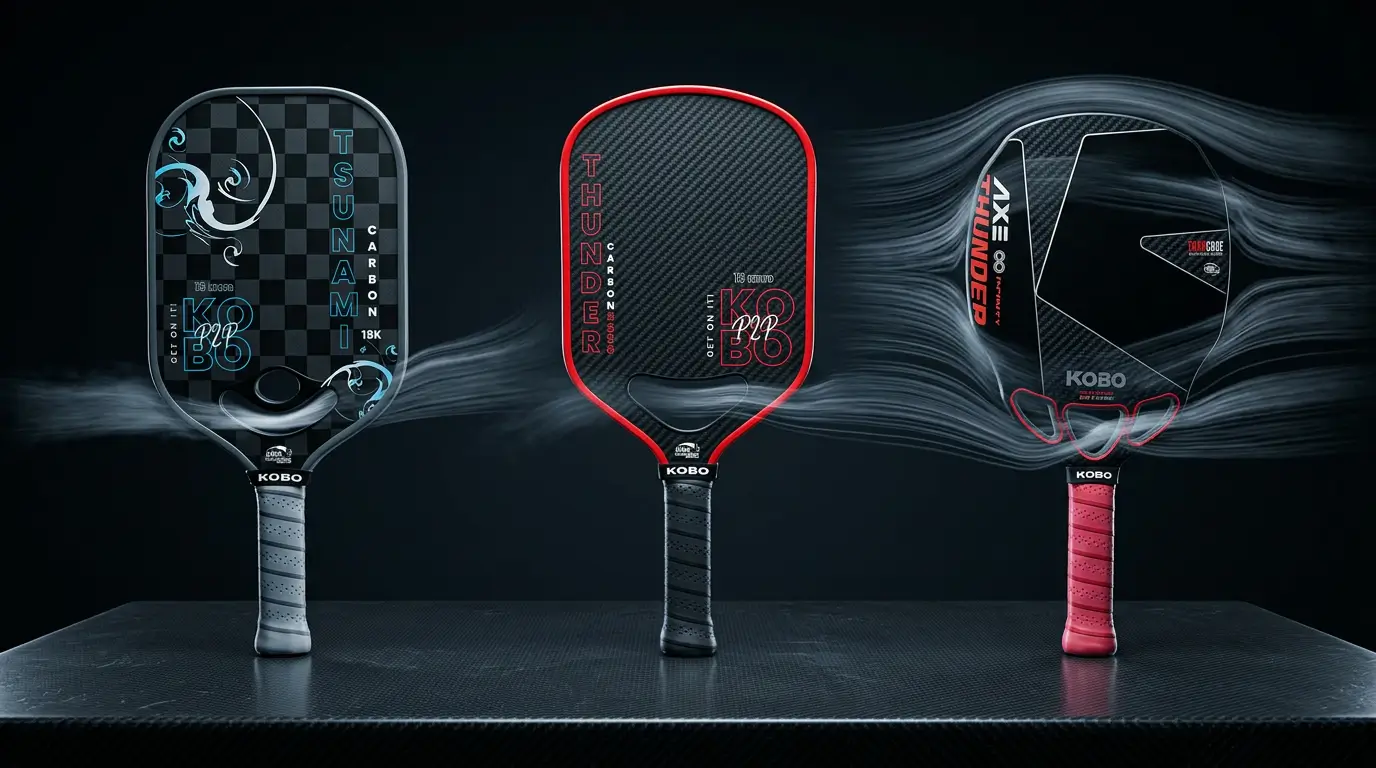
At the kitchen, “fast” rarely means making a large swing. It means presenting a stable face, changing direction, contacting the ball in front and recovering before the next attack. Paddle design can support that sequence, but technique still does most of the work.
Air channels can reduce solid area and remove material near the throat. That may alter aerodynamic drag, balance and rotational inertia. Ask whether the complete paddle recovers quickly while remaining stable for your contact.
The problem air channels try to solve
During a hands battle, the paddle repeatedly accelerates, stops and reverses. Total weight matters, but it does not describe how difficult the paddle is to rotate. Where the mass sits relative to the hand also matters. This is why two paddles with the same scale weight can feel different in motion.
Openings near the handle transition remove material from a specific region. Their contribution depends on size, shape, placement and the structure added around them. Reinforcement around an opening may add some material back.
Two different ideas: airflow and inertia
Aerodynamic drag
A solid face pushes air as it moves. Research on perforated paddle racquets shows that holes can change wake behaviour and drag, and that distribution matters—not only total open area. That study examined padel-style racquets, not a specific pickleball paddle, so it is useful context rather than direct proof of a performance gain.
Rotational inertia
Swingweight is resistance to angular acceleration around an axis near the handle. Sports-engineering research shows that mass and centre-of-mass location strongly affect it. Removing a few grams near the throat is not equivalent to removing the same mass near the tip.
Twist resistance concerns another axis. A paddle can feel easy to start yet twist on off-centre contact. “Fast” and “stable” must be evaluated separately.
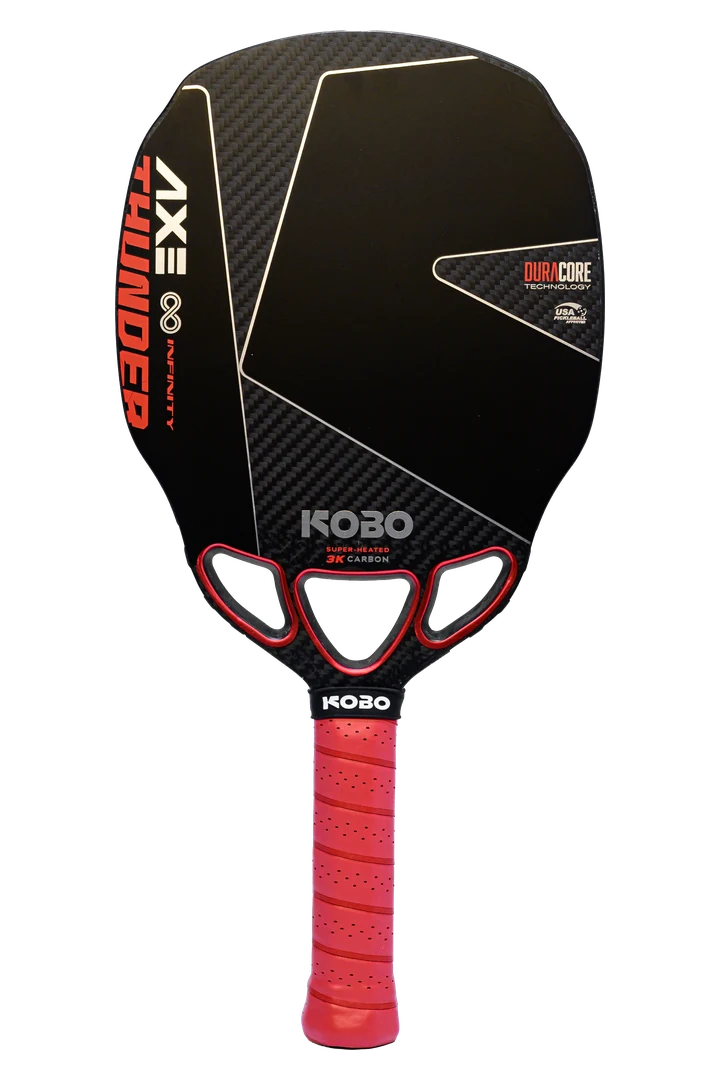
Face shape, perimeter construction, handle length, balance and mass distribution work together. The openings are visible; their isolated contribution is not.Interested in the air-channel design?Discover the Thunder AXE →
What a player may notice
- Preparation: whether the face reaches ready position without extra effort.
- Direction changes: whether forehand-to-backhand transitions feel controlled.
- Recovery: whether the paddle returns to neutral promptly after a counter.
- Stability: whether off-centre volleys hold their line or twist.
These are perceptions of the complete paddle. They cannot isolate the openings without controlled testing.
A practical five-minute comparison
- Use the same balls, partner and court conditions.
- Hit 20 alternating forehand and backhand volleys.
- Block 10 firm drives, including slightly off-centre contact.
- Play 10 counters from a neutral ready position.
- Score preparation, recovery and stability separately from 1–5.
Judge repeated contact, not only your best ball.
Claims to question
Be cautious with precise speed percentages unless the brand publishes the test method, comparison paddle, swing path and measurement uncertainty. “Aerodynamic” describes a design intention; it does not prove that every player swings faster.
A visible feature is easy to market. The playing result comes from the entire paddle.
For tournament play, confirm the exact model in the current USA Pickleball Approved Paddle List.
Thunder AXE uses three throat openings within a broader 18 mm design. Learn about the complete construction before deciding whether it fits your game.
Sources and further reading
- Flow physics of perforated paddle racquets
- Estimating racket moments of inertia
- Experimental proposal for racket manoeuvrability
- USA Pickleball Equipment Standards Manual
Editorial note: KOBO sells paddles with air-channel designs. This article separates general engineering evidence from product-design intent and does not claim one construction improves every player.