
Core thickness is useful because it gives you one visible clue about construction. It is limited because a paddle is a system: face material, core material and density, shape, mass, balance, perimeter reinforcement and manufacturing method all affect the result.
Within otherwise similar conventional honeycomb paddles, a thinner build often feels more direct and a thicker build often feels more muted or composed. Treat those as tendencies—not laws. Compare the complete paddles and judge the shots you actually play.
What does 14, 16 or 18 mm describe?
The millimetre figure normally describes the nominal thickness of the paddle’s core or body. In many paddles, two face sheets are bonded around a polymer honeycomb or foam structure. Changing the depth of that sandwich changes its geometry, but it may also bring changes in weight, stiffness, cell size, face layup or edge construction.
This is why “2 mm thicker” does not translate into a fixed amount of control, power or vibration reduction. There is no universal conversion from millimetres to performance.
What players commonly notice
14 mm: a more immediate conversation
A 14 mm paddle often communicates impact clearly and can feel crisp during drives, counters and put-aways. Players who already create soft touch may enjoy that direct response. The same liveliness can make a tense grip more obvious on resets and dinks.
16 mm: a useful reference point
A 16 mm construction is common because it can support an all-court balance of response and composure. It is not automatically neutral—some 16 mm paddles are powerful and others are restrained—but it is a practical baseline when you are learning what you prefer.
18 mm: more depth, not automatic control
An 18 mm build provides more structural depth and is often designed for a softer, steadier sensation on blocks and resets. Yet a lively foam, stiff face or strongly head-weighted shape can make a thick paddle behave very differently from that expectation.
Choose a thickness for the response you can repeat—not the label you believe should suit you.
What thickness cannot tell you
Thickness alone does not establish ball speed. USA Pickleball evaluates paddle performance through equipment tests, including paddle-ball coefficient of restitution, rather than approving performance from a thickness label. The current equipment standards also regulate dimensions and hitting-surface characteristics; they do not assign a required playing character to 14, 16 or 18 mm.
Thickness also does not reveal swingweight or twistweight. Two paddles with equal scale weight can resist rotation differently because their mass is distributed differently. Nor does the number identify the face stiffness, core density, perimeter weighting or the size of the effective hitting area.
Hold as many variables constant as possible. Comparing two thicknesses of the same paddle family is more informative than comparing unrelated models with different shapes, faces and balance.
Match thickness to the shot you need
Blocks and resets
If hard balls regularly rebound too high, begin by testing a more composed response—but also relax your grip and keep the face stable. A thicker option may help, yet technique remains the main control.
Drives and counters
If clean swings feel dull or require too much effort, compare a more direct response. Do not confuse “pop” on a short counter with power on a full drive; the two shots load the paddle differently.
Dinks and drops
Listen to height and depth, not just softness. The right paddle lets you reproduce a low trajectory under pressure. A plush sensation is valuable only when it produces predictable placement.
Hand battles
Core thickness is not a hand-speed measurement. Balance, swingweight, shape and grip comfort may matter more when you must stop, redirect and recover the paddle quickly.
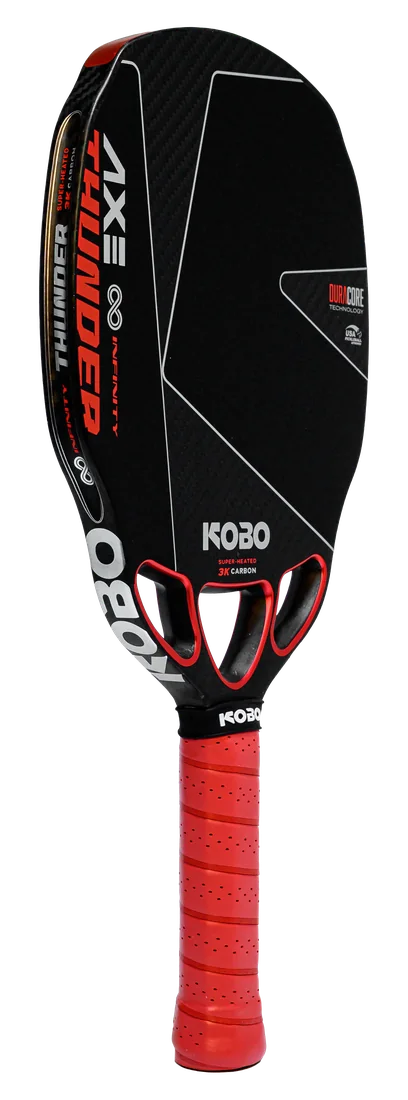
An 18 mm profile is only one part of Thunder AXE Infinity. Face construction, foam core, shape, edge structure, handle and mass distribution work together to create its response.Interested in the 18 mm design?Discover the Thunder AXE →
A ten-minute test that teaches you more
- Keep conditions stable. Use the same balls, court and partner.
- Start at the kitchen. Hit 10 crosscourt dinks, then 10 blocks against firm drives.
- Move back. Hit 10 third-shot drops and 10 controlled drives.
- Return to the line. Hit 20 compact counters, alternating forehand and backhand.
- Score four qualities separately. Rate launch predictability, off-centre stability, recovery speed and confidence from 1–5.
Do not choose from the single best shot. Choose the paddle that gives you the tightest group of acceptable results.
How KOBO uses the range
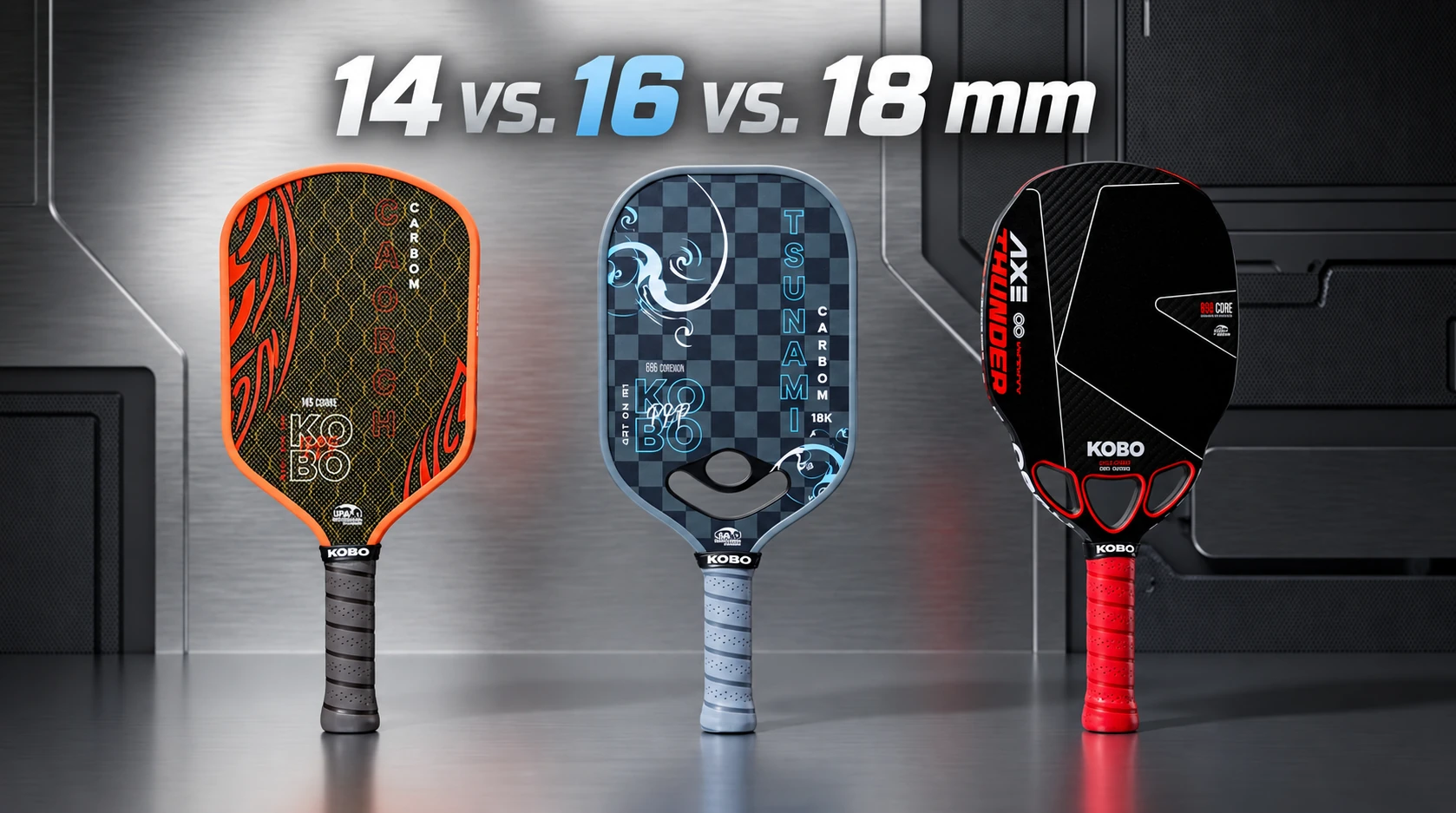
KOBO’s lineup uses different thicknesses for different design intentions. Scorch G4 pairs a 14 mm FoamTech core with an attacking profile. Several all-court models, including Tsunami 18K, use 16 mm constructions. Thunder AXE Infinity uses an 18 mm FoamTech core for a softer, more composed design direction. These descriptions explain intent; your own comparison determines fit.
Compare KOBO paddles → or use the paddle finder →
Sources and further reading
- USA Pickleball Equipment Standards Manual
- USA Pickleball: Paddle-Ball Coefficient of Restitution testing
- USA Pickleball paddle test methods
- Pickleball Science: Paddle dynamics and PBCoR
- Sports Engineering: estimating racket moments of inertia
Editorial note: KOBO sells paddles in multiple thicknesses. This guide separates common design tendencies from verified equipment standards and does not claim one thickness is best for every player.