
KOBO LEARN
Understand your paddle in plain language.
Practical explanations connected to dinks, drops, drives, blocks and the way you actually play.
FEATURED GUIDE · 11 MIN READ
How to choose a pickleball paddle for your playing style
A practical, research-informed process for matching shape, handling, response, stability and grip to the shots you actually play.
Read the complete guide →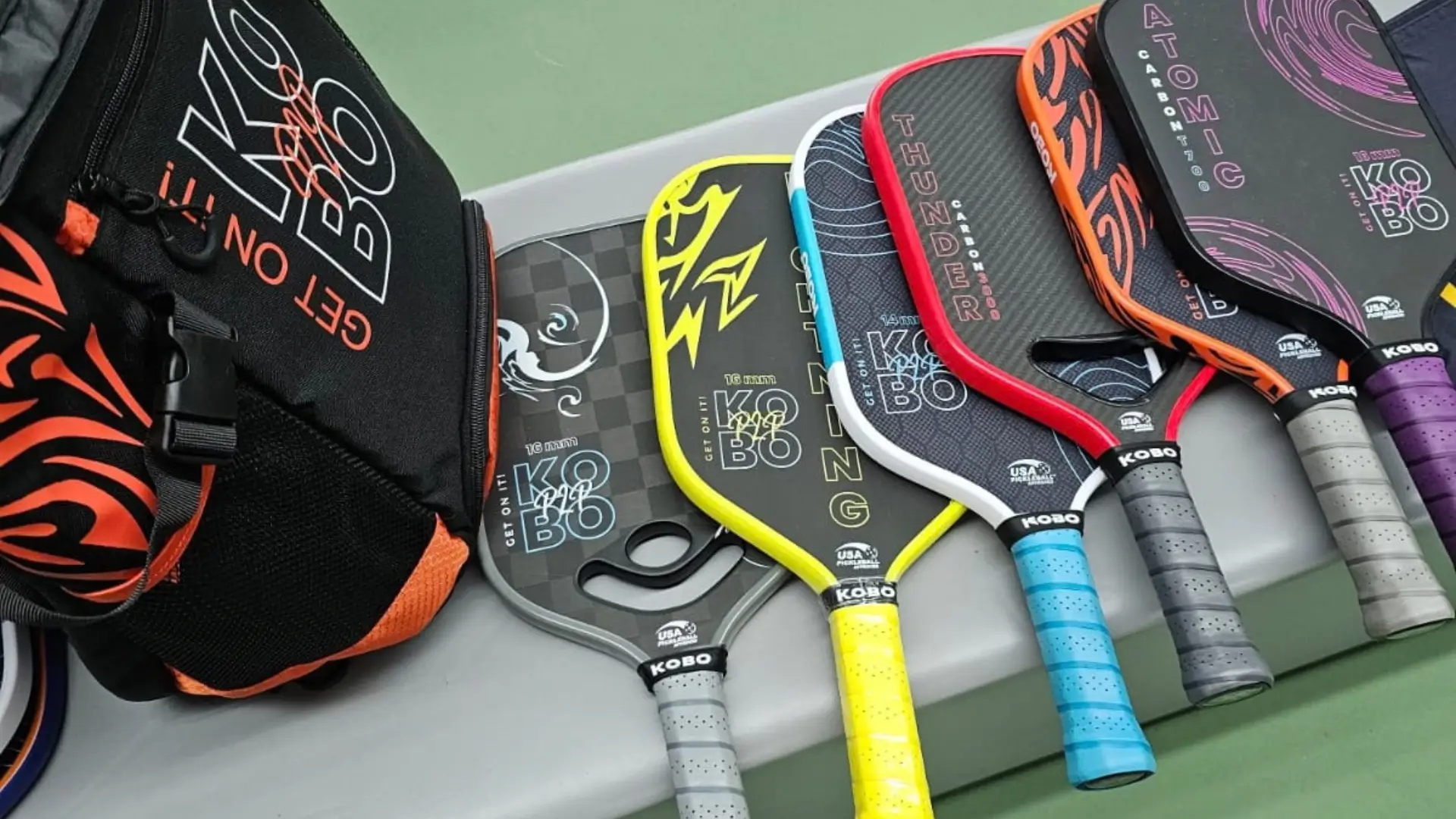
01 · CHOOSING A PADDLE · 11 MIN READ
How to choose a pickleball paddle for your playing style
Begin with the ball you miss, the exchange you lose and the shot you want to trust under pressure.
Start with your real problem
A paddle cannot replace footwork or timing, but it can make a useful quality easier to access. Think about recent games. Are your resets sitting up? Are drives landing short? Are you late in hands battles? Your most repeated problem is a better starting point than a long specification list.
Choose control, power or hand speed
Most all-court players need a blend. Select one priority, then decide which supporting qualities you are unwilling to lose.
Read Article #1 →02 · PADDLE DESIGN · 9 MIN READ
What air channels change in fast exchanges
The openings near the throat may influence airflow, mass distribution and how a paddle changes direction.
The practical goal: easier direction changes
At the kitchen, the paddle often travels only a short distance. The challenge is stopping it, changing direction and getting the face square before the next ball arrives.
Evaluate the complete paddle
Judge preparation, recovery and stability separately. A fast-feeling option is useful only if the face stays composed at contact.
Read Article #2 →03 · CORE THICKNESS · 10 MIN READ
14 mm, 16 mm or 18 mm: what actually changes?
Thickness is a useful construction clue—not a guarantee of power, control or comfort.
Look beyond the number
A thinner conventional core often feels more direct, while a thicker build often feels more composed. But face material, core density, shape, balance and perimeter construction can overturn that expectation.
Match the response to your shots
Judge blocks, resets, drives and counters separately. Core thickness is not a hand-speed measurement.