
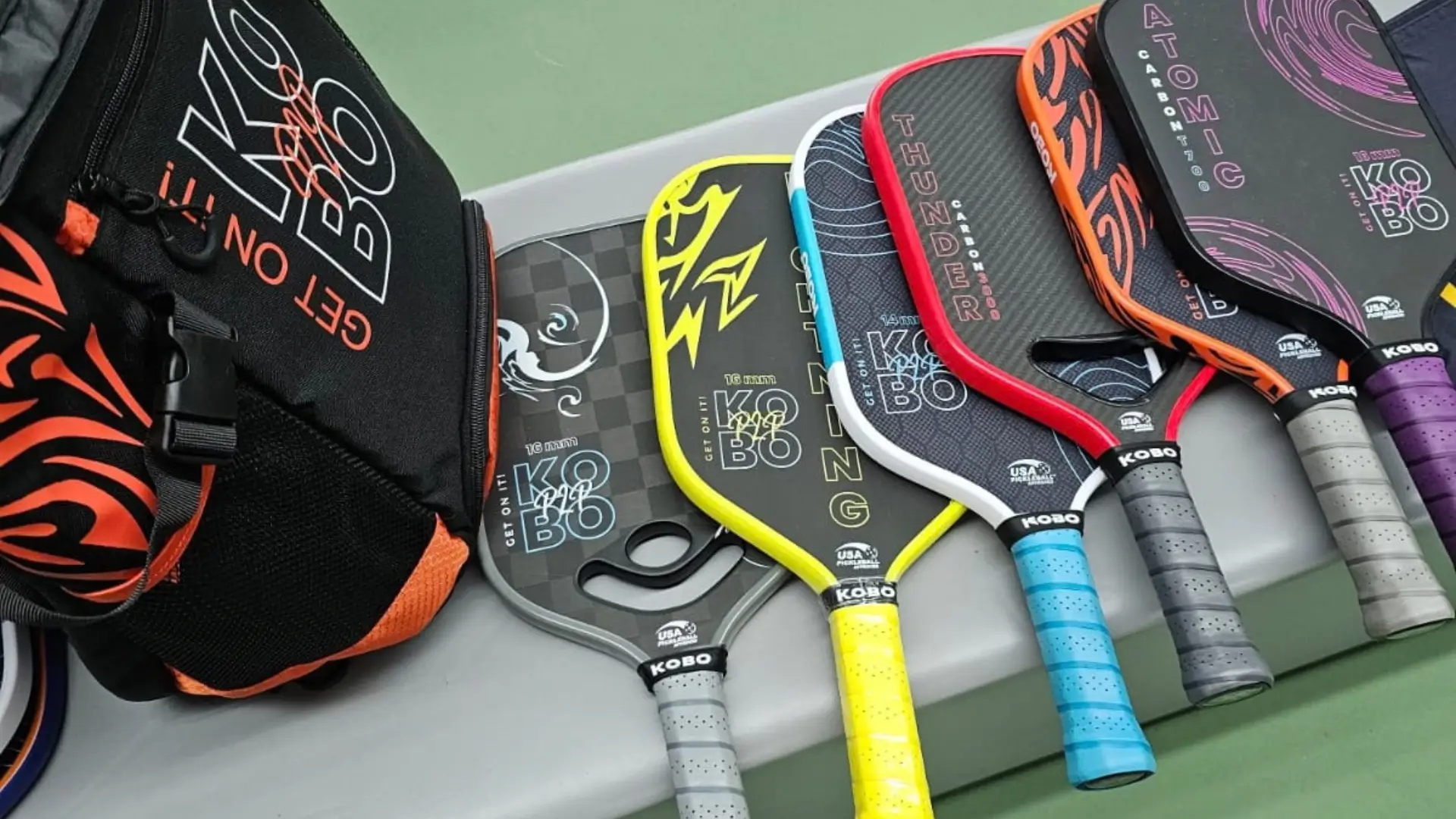
Paddle shopping often begins with materials—T700, 3K, 12K, 18K, foam, polymer—and ends with more questions than answers. A better process begins with the player. Identify the ball you miss, the exchange you lose and the shot you want to trust under pressure. Then use specifications to narrow the field.
Choose for your highest-priority constraint: control, easy pace, hand speed, reach or stability. Compare paddles with similar variables, play with them under realistic pressure, and judge the misses—not just your best shots.
Start with the point you are trying to solve
A paddle cannot repair late preparation, poor spacing or an inconsistent swing. It can, however, change how quickly the face arrives, how the ball responds at impact and how stable the paddle feels away from the centre. That makes equipment selection useful when it starts with a specific playing need.
- If resets and drops sit up: prioritize a predictable response and enough stability to absorb pace.
- If serves and drives lack depth: look for easier pace without choosing a response you cannot control in the kitchen.
- If you are late in hands battles: prioritize manoeuvrability and recovery rather than scale weight alone.
- If off-centre contact changes direction: prioritize torsional stability and a forgiving contact area.
- If you frequently reach outside your body: consider an elongated face, then confirm that the added reach does not slow your preparation.
Write down your first and second priorities. Everything else is a trade-off. “Maximum power, maximum control and maximum speed” is not a useful brief because those qualities are not independent.
The five decisions that matter most
1. Shape: reach, contact area and movement
A wider face generally gives you more lateral area for imperfect contact. An elongated shape moves more face area farther from your hand, increasing reach and often changing how substantial the paddle feels through the swing. A compact or aerodynamic shape may change direction more easily. Shape is not a verdict by itself: mass distribution and construction determine whether two similarly shaped paddles actually handle alike.
USA Pickleball’s equipment standard sets the legal envelope: combined paddle length and width may not exceed 24 inches, and length may not exceed 17 inches. Inside that envelope, designers distribute area differently. Tournament players should also confirm that their exact model appears in the current USA Pickleball Approved Paddle List.
2. Handling: static weight is only the beginning
Two paddles can weigh the same on a scale and feel completely different in motion. The reason is mass distribution. Weight farther from the hand contributes more to rotational inertia, commonly discussed as swing weight. More rotational inertia can make a paddle feel substantial through contact, but it can also demand more effort to start, stop and redirect. Weight concentrated closer to the hand can feel quicker even when total mass is similar.
Use scale weight as a screening number, not the final answer. Shadow swing, defend rapid volleys and recover from forehand to backhand. Your shoulder and forearm will tell you more than the product label.
3. Response: lively, composed or somewhere between
A lively paddle returns the ball with less player effort, which can help serves, drives and counters. A more composed response may make pace absorption and short placement easier. Core thickness often influences this sensation—14 mm constructions are commonly tuned for a more direct response, 16 mm for a broad all-court balance and 18 mm for a softer, steadier sensation—but thickness is not destiny. Face material, lay-up, foam, perimeter construction, shape and balance all matter.
Do not compare thickness while changing every other variable. If possible, compare similar shapes and balances. Otherwise, you may attribute a difference to the core that actually comes from mass distribution or surface construction.
4. Stability and forgiveness
“Sweet spot” is useful shorthand, but players should focus on outcomes: Does an off-centre contact twist the paddle? Does pace fall dramatically? Does the ball launch in the direction you expected? Wider geometry, perimeter reinforcement and mass distribution can all influence stability. A stable paddle is especially valuable for blocks, resets and hurried contact, where impact rarely lands perfectly in the middle.
5. Handle and grip: the connection you feel every point
Handle length affects space for a second hand and changes how far the face sits from the wrist. Grip circumference affects how securely you can control the face without squeezing excessively. USA Pickleball permits grip-size changes through wraps and approved grip systems, provided the finished paddle continues to meet equipment rules.
Do not compensate for an unsuitable grip by clenching harder. A 2025 study of 253 recreational players found that a self-reported tight baseline grip was associated with a higher likelihood of acute upper-extremity injury, although the authors emphasized the limits of self-reported data and the need for more research. The practical lesson is modest: choose a handle you can control with relaxed hands, and seek professional advice if pain persists.
Match the paddle to how you construct points
The control-first player
You win through placement, resets, patient dinks and selective attacks. Prioritize a predictable launch, stability during blocks and confidence on short swings. Test third-shot drops after a hard return; that transition exposes whether the response stays manageable when your timing is imperfect. Start with the Hydro guide or compare control-oriented options with the paddle comparison tool.
The aggressive driver
You create pressure with serves, returns, drives and counters. Prioritize easy acceleration and a response you can still contain on dinks. Test power after fatigue, because a paddle that feels exciting for five clean swings may become difficult when preparation shortens. Explore the Scorch G4 guide.
The fast-hands net player
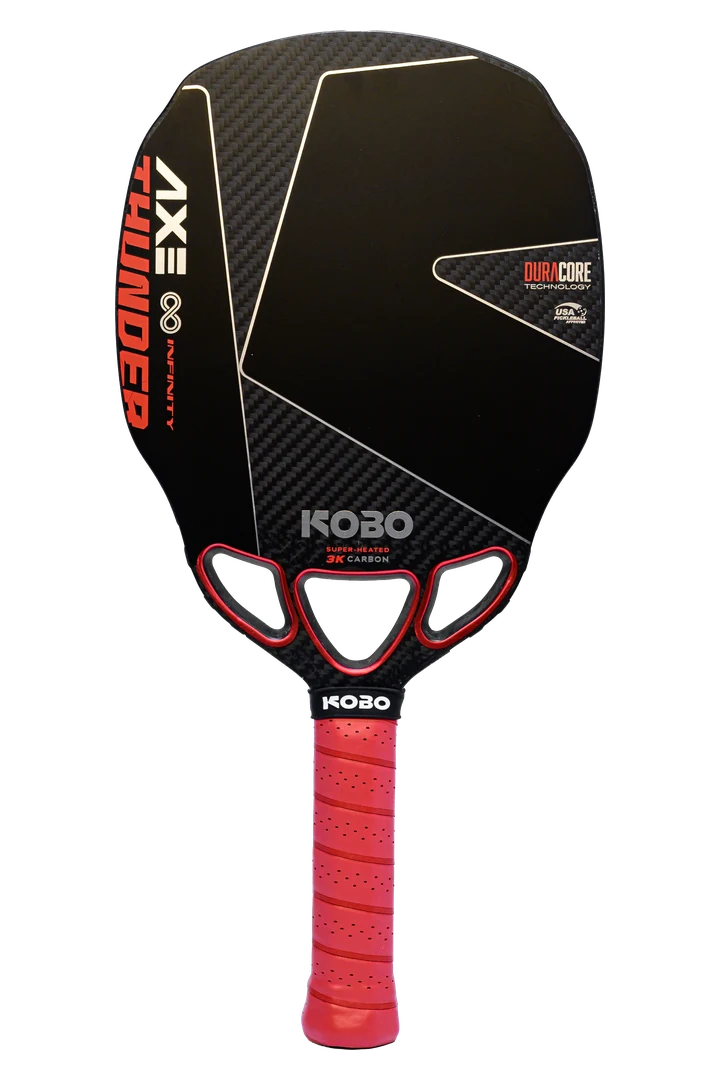
You win rapid exchanges near the non-volley zone. Prioritize direction changes, compact preparation and face stability against pace. Test alternating forehand and backhand volleys, then add body attacks. The paddle should return to neutral without forcing your wrist to do all the work. Explore the Thunder AXE guide.
The reach-and-spin player
You attack from the baseline, use topspin and value reach on stretched contact. An elongated profile may fit, but confirm that its balance does not make kitchen exchanges late. Test serves, third-shot drives, rolls and defensive volleys in the same session. Explore the Tsunami 18K guide or the Lightning guide.
The developing all-court player
You need a neutral reference point rather than an extreme. Choose manageable handling, predictable depth and sufficient forgiveness. A versatile paddle lets technique develop without requiring a different swing for every part of the court. Use the KOBO paddle finder to create a shortlist.
A 20-minute on-court paddle test
- Five minutes of soft play: cross-court dinks, straight-ahead dinks and resets from transition. Track height and depth.
- Five minutes of pace: serves, returns and drives. Judge repeatability, not the fastest single ball.
- Five minutes of defence: blocks, counters and alternating volleys. Notice twisting and recovery speed.
- Five minutes of pressure: play points starting in the situation you struggle with most.
Record three things: your common miss, the amount of conscious effort required and how the paddle feels after repeated exchanges. A good match reduces the frequency or severity of your costly miss without introducing a worse one.
Four common buying mistakes
Buying the material name
Carbon labels describe part of the construction, not the entire playing result. Surface, resin, lay-up, core, geometry and finishing interact. Never assume a larger “K” number is automatically better.
Using thickness as a personality test
Thickness is meaningful, but it is one variable. Treat “thin equals power” and “thick equals control” as starting hypotheses to test, not universal laws.
Ignoring certification status
USA Pickleball notes that certification applies to the tested model and that equipment must remain compliant through its lifecycle. Check the live database before a sanctioned event rather than relying only on a logo or an old product page.
Judging only clean contact
Nearly every premium paddle feels good when timing is perfect. Your purchase decision should be based on ordinary points: hurried blocks, stretched volleys, late contact and pressure drops.
The KOBO decision rule
Start with the game you actually play. Choose one primary problem, two qualities you must preserve and one trade-off you can accept. Build a shortlist, verify approval if you compete, and test under realistic conditions. Specifications should explain what you feel—not replace feeling altogether.
Sources and further reading
- USA Pickleball Equipment Standards Manual — paddle size, weight, construction and alteration rules.
- USA Pickleball Approved Paddle List — current searchable certification database.
- USA Pickleball Approved Equipment — testing, certification and lifecycle-compliance explanations.
- USA Pickleball: Fundamentals for Beginners — grip and ready-position fundamentals.
- Risk of Upper Extremity Injury in Recreational Pickleball Players — peer-reviewed survey study on playing volume and grip tightness.
Editorial note: KOBO manufactures and sells pickleball equipment. This guide separates official rules and cited research from KOBO’s practical product-selection framework. It is educational content, not medical advice. Individual experience varies.